How to Overcome Over-Productivity 🧘
Tips. Tricks. Hacks. The internet is full of them — and honestly? They've brought a lot of good into my life. I love the efficiency. The condensed knowledge. Being productive feels great.
But like salt — too much ruins the dish. 🧂
I started noticing it in myself. Having a reason for everything. An endless to-do list with no dopamine kick at the end. Being productive had quietly become its own kind of trap. And I'm not alone — so many millennials are craving a return to slower, more analogue times. Not because ambition is bad, but because somewhere along the way, busyness became a personality.
So no, I'm not saying productivity is bad. I'm saying too much of it is.
Here's what's helping me find the balance. 👇
Stop glorifying busyness 🛑
We've somehow convinced ourselves that being busy = being successful. That more of everything equals more happiness. Challenge that. What if we started glorifying downtime with the same energy? Pause. Seriously — just pause.
Less is more. Focus on impact, not effort 🎯
This is the one I work hardest on. Growing up Eastern European in the 80s, hustle was baked into me early — and it worked. But it also meant I always over-prepared, always operated at 110%. An annoying boss once gave me feedback I hated at the time: "less is more." She was right, however. My brain is always racing so fast, I thought I needed to be two steps ahead just to be noticed. The truth? Most people aren't following that closely. Did you really need Version_FFFF of that file? Did it actually move things forward faster? Slow down. Choose your battles.
Boundaries and priorities 🚧
These are different things, but deeply connected. If you struggle with boundaries like I do, try this: get clear on your priorities first — the boundaries start setting themselves. Every Friday morning I do Pilates. Non-negotiable. If work conflicts, I ask for flexibility, because that hour matters to me. Think of it like saving — pay yourself first. And remember: No is a decision; yes is a responsibility (attributable to James Clear, the guy from Atomic Habits).
Schedule nothing — and protect it 📅
Deliberately block time with zero agenda. Not rest-to-perform-better. Just... nothing. Boredom gets a bad reputation, but it's genuinely where creativity and self-awareness live. "Any plans Sunday?" Hell yes — absolutely nothing. And if I am don’t finish, I’ll continue tomorrow. 🦥
Get comfortable with incompleteness ✅
The list will never be finished. Ever. Accepting that isn't defeat — it's liberation. Done for today is a completely legitimate place to stop.
Bring back the low-ROI activities 🎨
Hobbies with no purpose. Walks without a podcast. A slow meal. A book that has nothing to do with your goals. The things you do purely because you enjoy them are what rebuild your identity beyond your output.
Stop optimising rest 😴
Sleep tracking, biohacking, strategic napping — at some point, even recovery becomes a productivity project. Sometimes rest just means doing less, messily, without measuring it. Let it be imperfect.
Overcoming over-productivity isn't a system or a hack. It's a slow, ongoing practice of choosing presence over performance — and then choosing it again the next day, when the pull to be busy comes back.
Because it always does. 💛
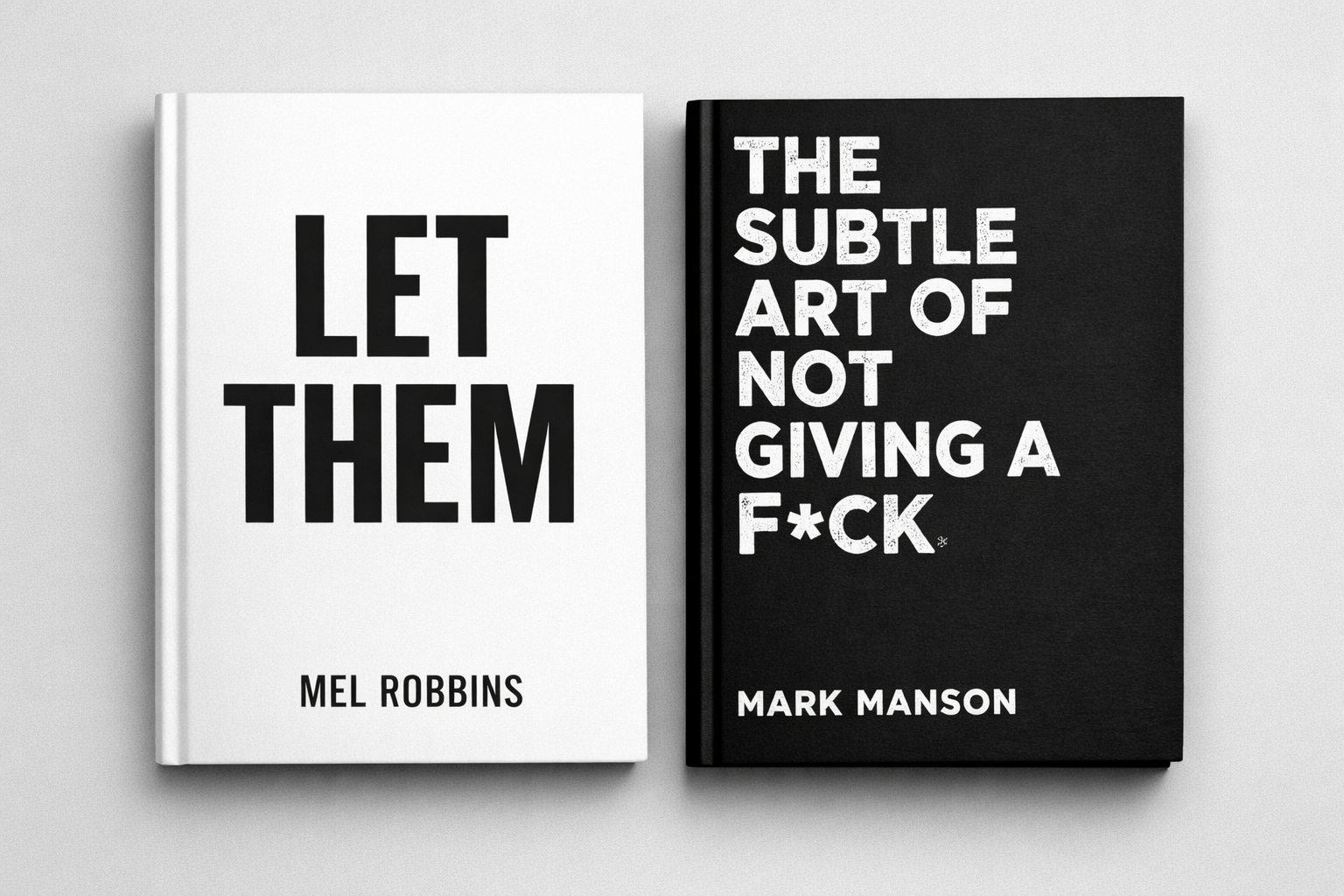
Let Them vs Subtle Art of Not Giving a F*ck
Just before Christmas, I saw Let Them by Mel Robbins and Subtle Art of Not Giving a F*ck by Mason side by side in a bookstore. The former came out last year and I have just finished reading it. The latter, I read a few years ago.
Going just by the title, they sounded similar and their message is somehow similar. Here are my nuggets of difference:
The Let Them Theory teaches people to stop trying to control others’ opinions, behaviour and expectations and to shift focus to what they can control (their own reactions and choices).
There are two parts of the idea:
“Let them” (allow others to act independently)
“Let me” (focus on your own actions and responses).
Manson’s approach is similar in the sense that he says you is:
What sort of goals should we have in a first place?
What sort of things should we give a fuck about?
I read both on Audiable. Let them is read by the author, but both versions are a really easy read.
Here are some tools I like from Manson’s approach.
CHOOSE YOUR STRUGGLE
If I ask you @What do you want out of life?” And you say something like, “I want to be happy and have a great family and a job I like,” the response is so common and expected that it doesn’t really mean anything.
What are the struggles I want in my life?
What pain do I want in my life?
What is worth struggling for?
What is worth valuing?
What is worth sacrificing for?
Mel’s approach has some good tips and I am going to say it. That I think will resonate with women more. Because in general women can be more nurturing and operating well in a group. So she gives some tips how to approach adults friendship, relationship tips and tricks and how to navigate family dynamics both with the extended family and your immediate one. And they are really like emotional and things that us as wife, mother, sister, friend has thought.
But all in all, both have the same philosophy to letting go of worrying about others’ opinions or controlling what you can’t. A framework that will help you reduce internal stress, and improve personal clarity.
New Year's resolutions edition: The Art of Letting Go
In the world where we are told to hustle, push and do more, I am exploring the idea of letting go.
The Art of Letting Go
Have you ever felt held hostage by your own dreams?
I am a goal-oriented person - a trait that serves me well when making New Year’s resolutions or when I push for something I really want.
Do you relate?
Have you ever, however, felt trapped by your own dreams?
I have. In fact, I can think of several work and personal examples where I pushed so hard for a goal or dream to come true that I failed to check in with myself to ask whether it was still something I truly wanted - or even needed.
In my end-of-year reading, I came across a passage that made me rethink goal-setting, especially if you’re someone who loves lists, resolutions, and plans.
The full text is below. It also made me think about the Chinese philosophy of Wu Wei (無為), or Shi De: effortless action - letting go in order to gain.
There’s important value in being willing to change your plans as your understanding of the world expands and grows more complex. Sometimes, the best thing you can do for yourself and the people around you is to have the wisdom to know which dreams to let go of in order to make room for something new. Some dreams undoubtedly propel us forward, but others hold us back. The trick is learning to distinguish between the two—and, when you decide an old dream no longer serves you, finding the courage to slip its bonds.
From The Next Day by Melinda French Gates